

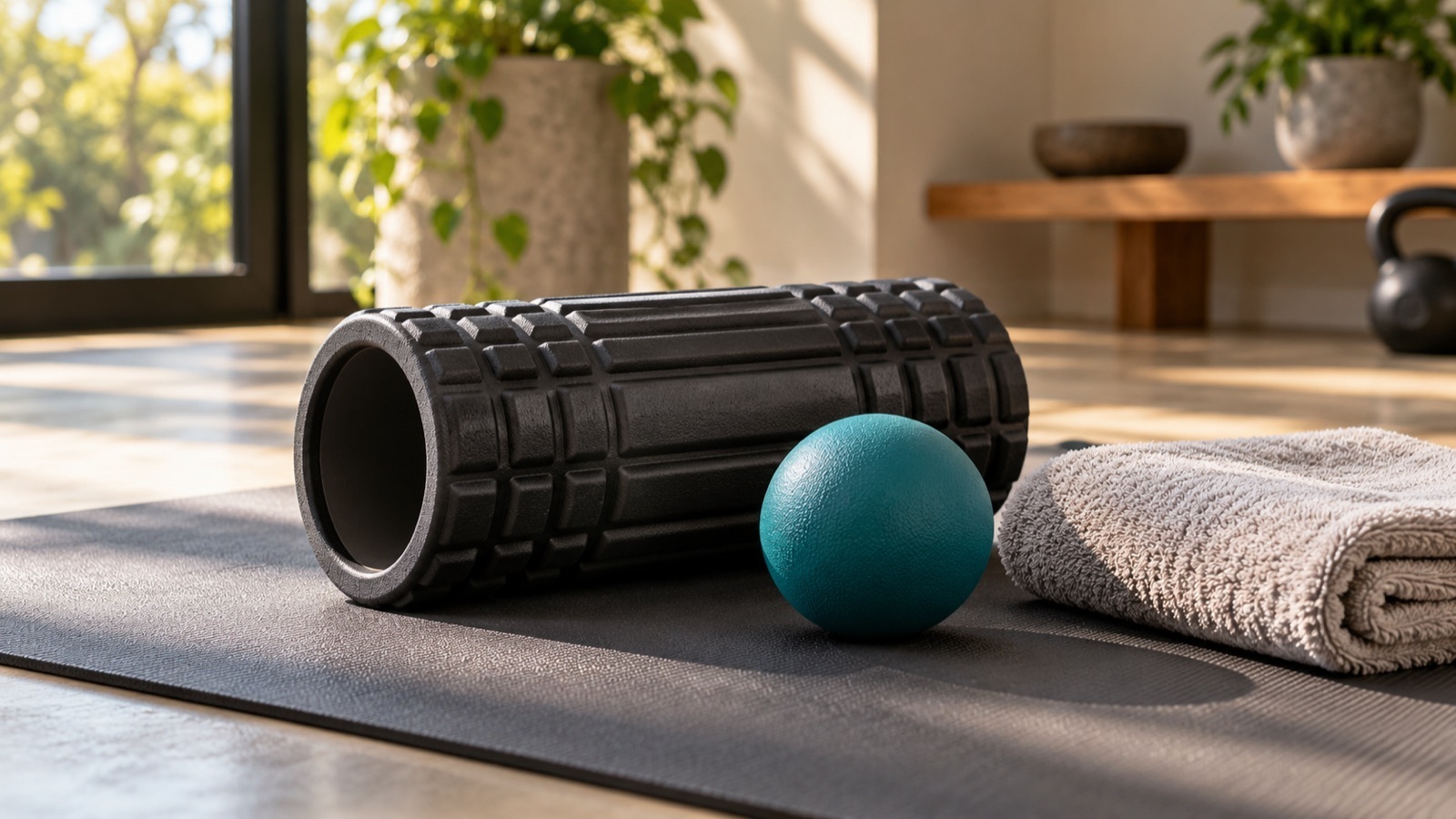
Feeling old and stiff does not automatically mean your age is the problem. Activity, long periods in one position, recovery, joint health and muscle sensitivity can all affect how freely you move. This routine explores five areas that often feel tight: the quads, calves, quadratus lumborum (QL), chest and muscles at the base of the skull. Gentle self-massage may help you feel more comfortable before movement, but it cannot identify the cause of persistent pain.
By Adam Villalobos, sports massage therapist and corrective exercise specialist. Updated October 31, 2026. Educational guidance, not a diagnosis or a substitute for individual care.
Start safely: use light, comfortable pressure. Stop for sharp pain, tingling, numbness, dizziness or symptoms traveling into a limb. Avoid injured, swollen or bruised areas, bones and joints. Ask a clinician before massage if you have a suspected blood clot, a recent operation, significant osteoporosis or a condition or medication that increases bleeding risk.
Why do I feel stiff as I get older?
Daily habits can leave some movements feeling unfamiliar or uncomfortable. Your thighs and calves work whenever you stand or walk. Your chest and shoulders spend hours positioned around a keyboard, steering wheel or phone. Your neck supports your head throughout the day. Training load, sleep and time spent moving also matter.
It is tempting to explain every ache as a muscle that has “locked short.” That is a useful coaching image in some situations, but it is not a diagnosis. Stiffness can involve joints, tendons, the nervous system and medical conditions as well as muscle. A feeling of tightness does not reliably tell you whether a muscle is physically short.
The aim here is modest: explore comfortable pressure, then check whether an everyday movement feels easier. You do not need to force a release or chase a painful spot.
Check your starting point before the routine
Stand near a stable support, soften your knees and bend forward only as far as comfortable. Notice the range without trying to touch the floor. Then sit upright and gently turn your head left and right. Record what feels restricted. Skip any movement that causes pain, dizziness or limb symptoms.
Repeat the same comfortable movements afterward. A short-term change can help you decide whether the routine feels useful; it does not prove which muscle caused the original restriction.
Watch Adam's full five-area routine on YouTube. Use the gentler pressure and stopping guidance in this written guide if a demonstration feels too intense for you.
Why might hamstring stretches feel helpful only briefly?
A temporary improvement from stretching is common. It does not necessarily mean you stretched the wrong muscle. Your tolerance for a position, how much you move during the day and the demands of your activities can all influence how the back of your thighs feels.
The front and back of the thigh both influence movement around the hip and knee. Exploring the quads as well as the hamstrings can be useful, but it is too simple to say that tight quads always pull the hamstrings to their limit. Pelvic position alone does not establish the source of pain.
In my Release, Restore, Retrain approach, comfortable soft-tissue work is an optional preparation for mobility and strength work. Massage does not replace either, and you do not have to eliminate all tightness before you exercise.
How do I foam roll my quads comfortably?
- Lie face down with your forearms supporting you and a roller under the muscular front of one thigh. Keep enough weight in your arms and other leg to control the pressure.
- Move slowly over a small area between the hip and knee. Stay off the kneecap and groin crease.
- If a spot feels mildly tender, reduce the pressure and pause briefly. Breathe normally. There is no need to reach a particular pain score.
- If comfortable, make a small bend and straighten movement at the knee while keeping the pressure light.
- Start with 30 to 60 seconds per side. Add time only if it feels helpful and does not leave lingering soreness.
No roller? Sit in a chair and gently massage the front of your thigh with the heel of your hand. You should remain in control of the pressure. Do not dig deeply into a painful point or keep rolling through tingling.
Can calf tightness affect knee and ankle movement?
The calf muscles help move the ankle, and the gastrocnemius also crosses the knee. A restricted or sensitive calf can influence how walking, squatting or ankle movement feels. That does not make it the explanation for every knee or ankle problem.
Sit comfortably with the leg supported. Use your hands to gently work over the fleshy part of the calf, avoiding the shin bone and the soft area directly behind the knee. Explore the back and sides without pinching aggressively. Start with 30 to 60 seconds, then move the ankle gently.
Do not massage a calf that is newly swollen, hot, red or unexpectedly painful. Seek prompt medical assessment, especially if the change is on one side. Stop if pressure causes a sharp or electric sensation into the foot.
What should I do about one-sided low-back tightness?
The quadratus lumborum, or QL, lies between the pelvis and the lower ribs on each side of the low back. It contributes to trunk movement and stability. Sitting or leaning in one position can make this region feel overworked, but you cannot identify a QL problem simply by looking at pelvic height or apparent leg length.
For a gentle approach, stand against a wall with a soft ball over the muscular area beside the low back. Stay away from the spine and lower ribs. Use a broad, light contact rather than trying to press deep into the abdomen or kidney area. Shift your weight slightly for a few comfortable breaths, then move away.
If you are unsure where to place the ball, use your hand or ask a qualified professional to show you. Avoid deep pressure. Stop if pain travels down your leg. New bladder or bowel changes, numbness around the groin, or significant leg weakness require urgent medical attention.
Can chest tightness contribute to shoulder discomfort?
The pectoralis minor sits beneath the larger chest muscle and attaches to the shoulder blade. Shoulder positioning and chest muscle sensitivity can be relevant to upper-body comfort. Arm tingling, however, has several possible causes and should not be assumed to come from a tight pec minor.
Use the pads of your fingers to apply light pressure to the broad upper-chest muscle, below the collarbone and away from the armpit. Keep your arm supported. If comfortable, slowly move the arm through a small range. Start briefly and reassess; deep pressure is unnecessary.
Stop entirely if you feel numbness, tingling or pain traveling into the arm. Do not keep searching for a spot that reproduces those symptoms. If they recur, arrange an assessment. Our guide to thoracic outlet syndrome tests and their limits explains what symptom checks can and cannot tell you.
How can I ease tension at the base of my skull?
The suboccipital muscles help with small head movements. For some people, gentle contact around this area feels relaxing. Headaches and neck pain have many causes, so improvement with massage does not establish a diagnosis.
Sit with your head supported. Use your fingertips for light contact just below the back edge of your skull, beside rather than on the spine. Make small, slow movements for a few breaths, then rest. Do not use forceful pressure, a hard tool or a roller on the neck. Stay off the front and sides of the neck.
Stop for dizziness, nausea, visual changes, shooting pain or a worsening headache. A sudden severe headache, especially with weakness, confusion or a new neurological symptom, needs emergency care.
Frequently asked questions
How often should I use this routine?
Start with short sessions and see how you feel later that day and the next morning. You do not need to work every area every day. Reduce the pressure or frequency if you become sore. Regular comfortable movement is more important than repeatedly chasing tender spots.
Should self-massage hurt?
No. Use pressure that feels comfortable and lets you breathe normally. More pain is not evidence of a better result. Stop for sharp, electric, burning or spreading symptoms.
Do I need special equipment?
A soft massage ball, a foam roller and your hands offer different ways to control pressure. Your hands are a good starting point because you can adjust immediately. Avoid hard tools around the neck and other sensitive areas.
When should I seek professional care?
Get assessed for persistent or worsening pain, recurring numbness, loss of strength, unexplained swelling or changes in limb colour or temperature. Do not delay care because a massage temporarily changes the symptoms.
Your next step
Choose one comfortable area, use gentle pressure briefly, then try an easy movement again. Keep the parts that help you move comfortably and leave the parts that aggravate you.
If upper-body tingling is part of the picture, explore the free TOS Toolkit and five symptom checks. These are educational resources to support a conversation with a clinician; they cannot diagnose the cause of nerve symptoms.
About the author
Adam Villalobos is a sports massage therapist, corrective exercise specialist and Army veteran based in Chula Vista, California. His Train and Massage education uses the Release, Restore, Retrain approach to connect soft-tissue work with movement and exercise.

